- Primary or weathered rock where crushing and grinding duties need definition
- Projects assessing gravity recovery inside a controlled grinding circuit
- Existing plants with known recovery, liberation or circulating-load problems
Primary and weathered gold ore
Hard Rock Gold Processing
The route starts with gold association and liberation, not with a ball mill model.
Crushing, grinding and recovery routes developed from liberation, mineralogy and test response rather than a fixed machine package.
Manual process review
I first separate free-gold opportunities from sulphide-associated or refractory risks before discussing a machine package.
First reply within one business day Before a machine model
Check whether this route fits the ore.
The mineral name is only the starting point. These conditions decide whether this page is relevant or whether another test route is needed.
- Gold is mainly locked in sulphides or fine mineral associations
- The required liberation size is unknown or based only on visual inspection
- Flotation or leaching may be necessary to treat gravity tailings
Three-question route check
Tell me how the material behaves.
These answers do not produce a final plant design. They help us identify the likely process direction, the missing evidence and the first risk worth checking.
1 association 2 preparation 3 liberation
The route depends on where the gold is
Two ores with the same head grade can require completely different plants. Coarse liberated gold in quartz may respond well to staged gravity recovery. Fine gold associated with sulphides may need a flotation or leaching route. Weathered ore can behave differently from fresh ore from the same deposit.
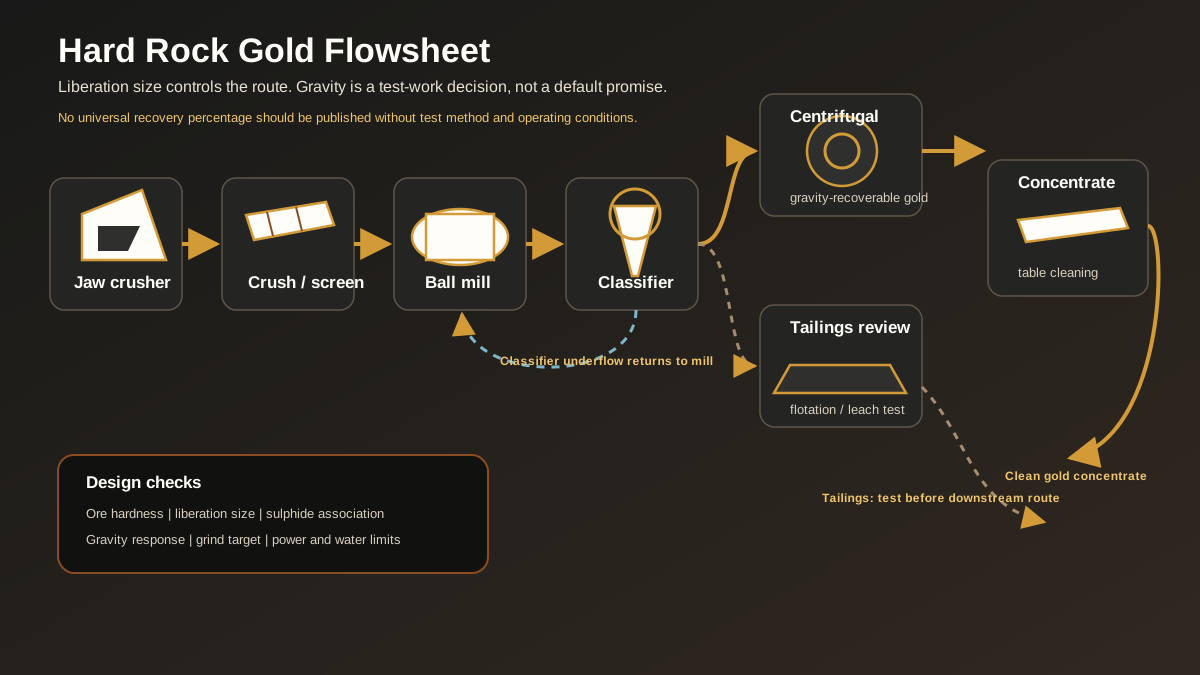
That is why a crusher, ball mill and concentrator package is not a complete process design. The route must define how much size reduction is required, where gravity recovery should occur, how circulating load is controlled and what happens to gold that gravity does not recover.
Gravity recovery is valuable when it removes the right material
Recovering liberated gold early can reduce inventory, shorten exposure to downstream losses and create a high-grade product. It works best when the feed stream is controlled and the concentrator is integrated into the grinding circuit.
Feeding an unclassified, unstable or excessively dilute stream into a centrifugal concentrator can make an otherwise suitable machine perform poorly. The surrounding circuit matters as much as the separator.
Detailed design needs representative test data
An initial assessment can identify a plausible flowsheet and the tests still required. Equipment sizing and performance expectations should be based on representative samples, throughput assumptions, hardness, water balance and the intended operating schedule.
We do not publish a universal recovery percentage. Any project result must be tied to the ore, grind size, test method and operating conditions that produced it.
Typical process logic
Open each stage to see the duty it performs. Test data can remove, add or change a stage before equipment is sized.
01 Characterize the ore
Combine assays, mineral observations and representative test work to identify where the gold occurs.
02 Crush in stages
Reduce top size reliably while controlling fines, recirculating load and downstream feed consistency.
03 Grind to a justified size
Target the liberation needed for the selected recovery route instead of grinding finer by habit.
04 Recover gravity gold
Remove recoverable liberated gold at the correct point in the grinding circuit when tests support it.
05 Select the downstream route
Evaluate flotation, leaching or combined treatment only when mineralogy and test results justify the added complexity.
Why equipment appears in the route
These are process duties, not a shopping list. Feed conditions and mass flow decide whether a machine belongs in the final scope.
Jaw and secondary crushers
Create a controlled mill feed through staged reduction, screening and recirculation.
Ball mill and classifier
Establish the particle-size distribution needed for liberation and maintain a stable circulating load.
Centrifugal concentrator
Recovers suitable liberated gravity gold from a controlled stream, commonly within the grinding circuit.
Shaking table
Cleans a small, pre-concentrated gravity product; it is not normally the primary machine for unclassified mill feed.
Case notes to compare with your ore
A reference case shows how a previous scope was reasoned. It is not a design recommendation for a different deposit.
Australia 30 TPH
Australia 30 TPH Rock Gold Fine Recovery Reference
A medium-small rock gold reference case focused on fine gold recovery, water circulation and a low-civil-work gravity route without a ball mill.
Compare project conditions Malaysia 50 TPH
Malaysia 50 TPH Rock Gold Processing Line Reference
A standard hard-rock gold reference case covering feeding, crushing, grinding, gravity concentration and smelting support.
Compare project conditionsFrequently asked questions
Is gravity concentration enough for every hard rock gold ore?
No. Gravity can recover liberated high-density gold, but gold locked in sulphides or fine mineral associations may require flotation, leaching or another tested route.
How fine should the ore be ground?
The target grind should be selected from liberation and recovery tests. Grinding finer than necessary increases power, wear and slime production.
Can you provide flotation or leaching test work?
Our stable in-house focus is gravity amenability testing. Additional flotation or leaching programs are coordinated with suitable laboratories when the project requires them.
Send the ore facts before we size the hard rock gold processing route.
Share the mineral, target capacity and what you already know about the feed. We will review the project within one business day.