- Placer or rock tungsten with defined mineral identity and gravity response
- Circuits that can recover liberated coarse tungsten before selective regrinding
- Existing plants reviewing middlings, fine losses or concentrate cleaning
Wolframite and scheelite recovery
Tungsten Ore Processing
Tungsten design starts by identifying the mineral and protecting it from overgrinding.
Gravity-led tungsten routes built around mineral type, liberation size, fine-particle losses and concentrate cleaning requirements.
Manual process review
I first distinguish wolframite, scheelite and mixed ore, then check where fine losses and cleaning limits occur.
First reply within one business day Before a machine model
Check whether this route fits the ore.
The mineral name is only the starting point. These conditions decide whether this page is relevant or whether another test route is needed.
- Scheelite or mixed mineralogy makes a gravity-only route incomplete
- A large share of tungsten reports to slimes or very fine sizes
- Sulphides and impurities require additional cleaning stages
Three-question route check
Tell me how the material behaves.
These answers do not produce a final plant design. They help us identify the likely process direction, the missing evidence and the first risk worth checking.
1 mineral 2 source 3 loss
Tungsten recovery starts with mineral identification
Wolframite and scheelite are both dense, but they do not create identical process decisions. Magnetic behavior, associated minerals, liberation size and final concentrate specifications affect both roughing and cleaning.
An early mineralogical check prevents the plant from being designed around an assumed tungsten species that does not match the ore.
Stage reduction and recover liberated particles early
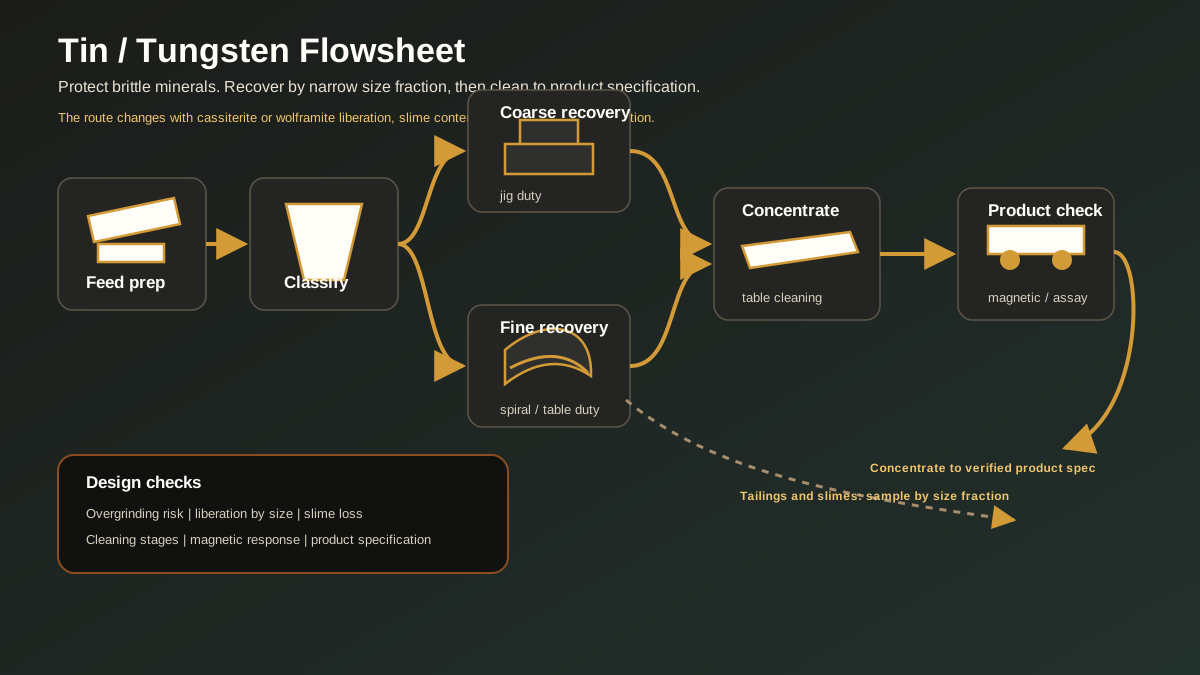
The objective is not to grind the entire feed to the finest visible tungsten grain. A staged circuit can recover liberated coarse material, classify the remaining feed and selectively regrind middlings that still contain composites.
This reduces avoidable fines and lets the process team measure where tungsten is moving through the circuit. It also creates a more stable feed for jigs, spirals and tables.
Fine losses require evidence, not a fashionable machine
Fine tungsten may be recoverable, but equipment selection should follow size-by-size test work and realistic mass-flow calculations. A device that performs well on a laboratory sample can be overloaded or diluted when inserted into a full plant without a balanced classification circuit.
Final design should include sampling points so that losses can be measured and operating changes can be based on data.
Typical process logic
Open each stage to see the duty it performs. Test data can remove, add or change a stage before equipment is sized.
01 Identify the tungsten mineral
Confirm whether wolframite, scheelite or a mixed occurrence controls the separation strategy.
02 Liberate without overgrinding
Use staged crushing or grinding with classification to avoid creating avoidable fine losses.
03 Recover by size fraction
Route coarse and fine liberated particles to gravity equipment suited to their settling behavior.
04 Regrind middlings selectively
Regrind only composite streams that require additional liberation instead of the entire feed.
05 Clean and verify product quality
Assess magnetic, sulphide or other impurity removal according to concentrate mineralogy.
Why equipment appears in the route
These are process duties, not a shopping list. Feed conditions and mass flow decide whether a machine belongs in the final scope.
Screens and hydraulic classifiers
Create narrow, stable size fractions before gravity separation.
Jig
Recovers appropriate coarse liberated wolframite or scheelite where density contrast is useful.
Spiral concentrator
Provides roughing capacity for selected finer fractions with controlled feed conditions.
Shaking table
Produces a cleaner heavy-mineral fraction and helps separate concentrate, middling and tailing streams.
Case notes to compare with your ore
A reference case shows how a previous scope was reasoned. It is not a design recommendation for a different deposit.
Tanzania 10 TPH
Tanzania 10 TPH Tin Tungsten Gravity Reference
A compact tin-tungsten alluvial reference case showing washing, classification, jig recovery and shaking table cleaning.
Compare project conditionsFrequently asked questions
Can tungsten ore be processed exactly like tin ore?
The circuits share gravity principles, but mineral type, liberation, brittleness, associated sulphides and product requirements can change the sequence.
Why avoid overgrinding tungsten ore?
Fine valuable particles are more difficult to recover by conventional gravity methods and can increase circulating load and water-management problems.
When is flotation considered?
Flotation may be evaluated for fine scheelite or sulphide-related problems, but it should follow mineralogical and metallurgical testing.
Send the ore facts before we size the tungsten ore processing route.
Share the mineral, target capacity and what you already know about the feed. We will review the project within one business day.