- Chromite ore or tailings with representative grade and size information
- Projects requiring washing, classification and staged gravity assessment
- Existing lines reviewing slime losses, middlings or product quality
Chromite washing and gravity separation
Chrome Ore Processing
Chrome design starts with liberation, Cr/Fe requirements and the material that must be rejected.
Washing, classification and gravity concentration for chromite ore or tailings, designed around liberation, slimes and product specification.
Manual process review
I first check whether the feed is primary ore, placer material or old tailings, then review clay, size and buyer specification.
First reply within one business day Before a machine model
Check whether this route fits the ore.
The mineral name is only the starting point. These conditions decide whether this page is relevant or whether another test route is needed.
- Chromite is not sufficiently liberated at the proposed feed size
- Cr/Fe ratio or impurity limits matter more than Cr2O3 grade alone
- Fine slimes dominate the remaining chromite inventory
Three-question route check
Tell me how the material behaves.
These answers do not produce a final plant design. They help us identify the likely process direction, the missing evidence and the first risk worth checking.
1 source 2 clay 3 product
Product specification matters as much as head grade
A chrome circuit is designed to produce a usable concentrate, not simply a heavy fraction. The required Cr2O3 grade, Cr/Fe ratio, size specification and impurity limits influence the amount of cleaning and the acceptable mass recovery.
The process should therefore start with both feed characterization and a clear product target.
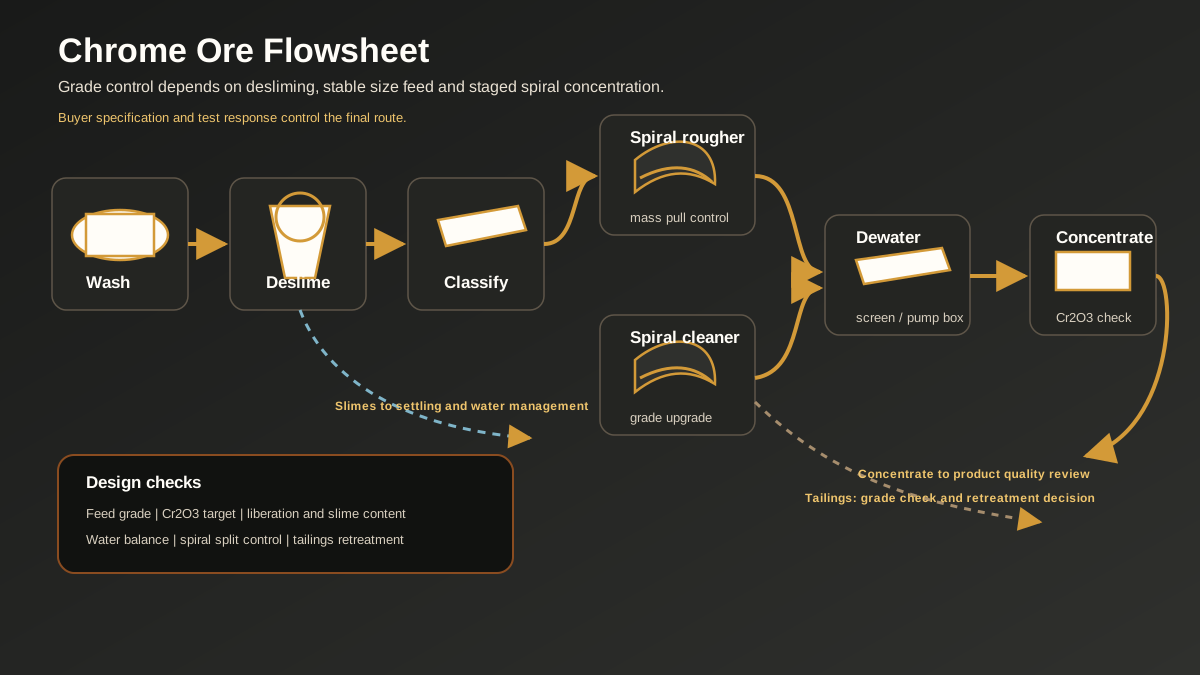
Washing and classification stabilize the separator feed
Clay and ultrafine material can alter slurry flow, consume water and reduce the selectivity of spirals or tables. Oversize particles create a different problem: they may be poorly liberated or operate outside the efficient range of the selected separator.
A balanced circuit removes or separately treats these problematic fractions before gravity roughing.
Tailings retreatment needs a mass-balance view
Old tailings can contain recoverable chromite, but a promising pan sample is not enough. The project needs representative sampling, size-by-size assays and an estimate of total available tonnage.
The test program should establish concentrate grade, mass pull and where losses remain. Those results determine whether retreatment can support the water, power, equipment and handling costs.
Typical process logic
Open each stage to see the duty it performs. Test data can remove, add or change a stage before equipment is sized.
01 Characterize feed and product target
Confirm grade, size distribution, liberation and the concentrate quality required by the buyer.
02 Wash and deslime
Remove clay and control ultrafine material that can disturb gravity separation.
03 Classify the feed
Establish suitable size ranges for roughing and prevent coarse particles from masking fine recovery.
04 Rough and scavenge
Use staged gravity separation to recover chromite while maintaining manageable mass pull.
05 Clean and recycle middlings
Upgrade concentrate and return only the streams that benefit from re-treatment.
Why equipment appears in the route
These are process duties, not a shopping list. Feed conditions and mass flow decide whether a machine belongs in the final scope.
Scrubber and screen
Releases clay-bound material and controls oversize before the separation stages.
Spiral concentrator
Provides high-capacity roughing for suitably classified chromite-bearing sand.
Shaking table
Cleans selected fine heavy-mineral fractions where feed stability and water control are available.
Dewatering equipment
Returns process water and prepares concentrate or tailings for practical handling.
Frequently asked questions
Can low-grade chrome tailings be retreated?
Potential depends on remaining chromite grade, size distribution, liberation and the mass of material available. Representative testing is required.
Why is desliming important?
Excess ultrafines can increase slurry viscosity, disturb flow behavior and carry fine chromite into tailings or dilute concentrate.
Can a target Cr2O3 grade be guaranteed from an assay alone?
No. Product grade and recovery depend on liberation, gangue minerals, particle size and the tested separation response.
Send the ore facts before we size the chrome ore processing route.
Share the mineral, target capacity and what you already know about the feed. We will review the project within one business day.